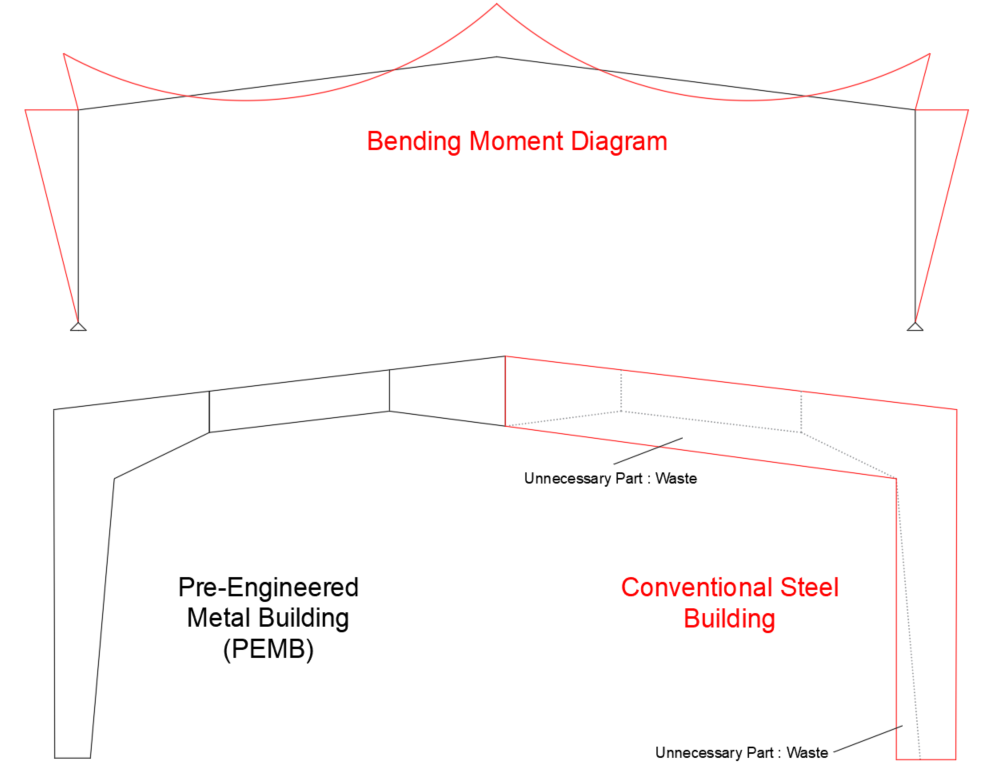
Pre-Engineered Metal Building (PEMB)
The use of single-story steel structures has been rapidly increasing worldwide. These buildings are generally categorized into two main types based on their design concepts: Conventional Steel Buildings (CSBs) and Pre-Engineered Metal Buildings (PEMBs). In CSBs, standard hot-rolled I or C sections are typically used; however, these members are often heavier than necessary for the design requirements. In contrast, PEMBs employ tapered members whose cross-sectional dimensions vary along their length according to the required resistance to internal forces, particularly bending moments.
This variable-section design concept enables a more efficient distribution of material, since steel is provided where it is structurally needed and reduced where the demand is lower. As a result, PEMBs generally achieve a lower overall structural weight compared with conventional steel buildings designed for similar spans and loading conditions. The reduction in steel tonnage not only improves material efficiency, but also contributes directly to lower fabrication, transportation, and erection costs.
Therefore, MkaPEB enables users to analyze and design pre-engineered metal buildings (PEMBs).