Importance of Code Compliance
In structural engineering, the quality, safety, and economy of a design depend on many factors, including design assumptions, analysis methods, member selection, and the loads considered during the design process. Among these, loading is one of the most fundamental parameters. Structural design codes such as ASCE 7, and related standards define the minimum loads and load combinations that must be considered to ensure the safety and reliability of buildings.
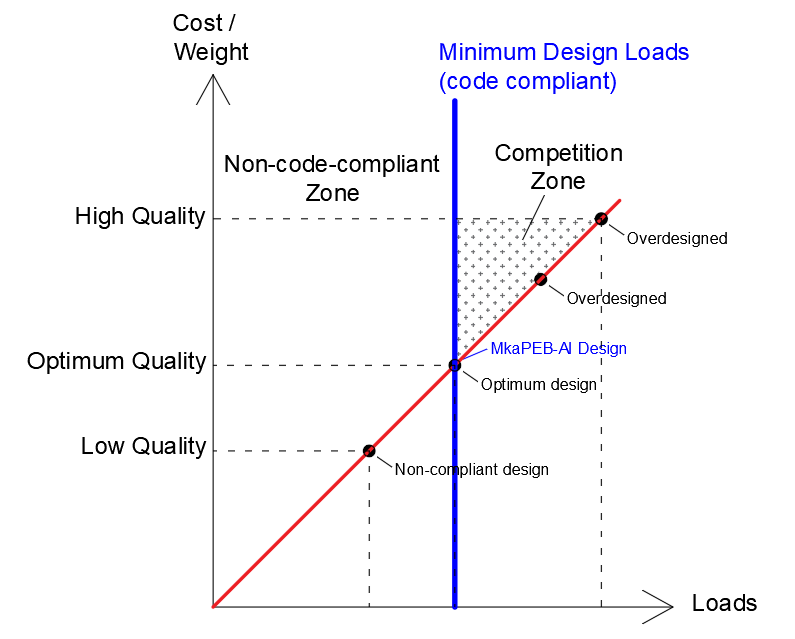
In practice, however, minimum load requirements are sometimes neglected in the design of pre-engineered metal buildings (PEMBs). If the loads considered in the design are lower than the minimum loads required by the design code, the resulting structure may appear economical due to reduced steel weight, but such a design may become non-compliant with code provisions and may not provide the intended level of structural safety.
A non-code-compliant design is not merely a technical deficiency; it is a long-term legal, financial, and reputational risk for the manufacturer, contractor, and project stakeholders. If the building experiences excessive deflection, serviceability problems, damage under snow or wind, partial failure, or a more serious structural incident, the first question raised by the owner, insurer, consultant, or legal authority will be whether the structure was designed in accordance with the governing code requirements. If it is found that the requirements were underestimated or omitted, the responsibility may fall directly on those who designed, approved, fabricated, or constructed the building.
This risk is particularly critical because non-compliance is not always visible at the time of construction. A building may appear satisfactory for years, while the underlying design deficiency remains hidden until an extreme event, change of use, future expansion, insurance review, or technical audit exposes it. In many cases, companies do not even realize that they are carrying this risk, especially when simplified loading assumptions have become routine practice. However, once a failure or claim occurs, lack of awareness is not a defense. The risk remains with the responsible parties for the life of the structure. For this reason, code-compliant loading should not be viewed as an optional design refinement, but as a fundamental requirement for reducing liability and protecting both the project and the company behind it.
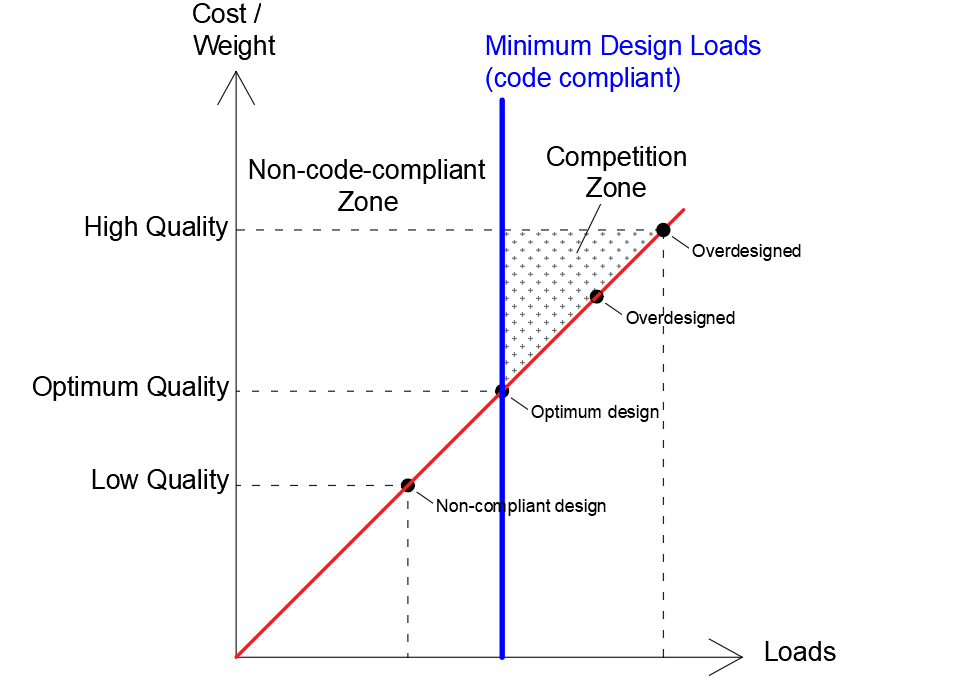
On the other hand, designers may sometimes adopt overly conservative assumptions in order to avoid risk or simplify calculations. An overdesigned solution is unfavorable from a business and engineering perspective. Although such a design may satisfy code requirements, it increases steel tonnage, connection demands, fabrication effort, transportation weight, and erection cost without delivering proportional value. In a highly competitive market such as pre-engineered metal buildings, even a modest increase in structural weight can significantly reduce profit margin or make an offer less competitive. Overdesign therefore does not represent added intelligence or added safety beyond what is required; in many cases, it reflects inefficiency in load definition, member selection, or optimization strategy.
Moreover, overdesign can have cascading effects throughout the entire project. Heavier primary members may require larger secondary members, stronger connections, heavier anchor rods, larger base plates, and more expensive foundations. This means that unnecessary conservatism in the initial design stage can propagate into multiple cost increases across fabrication and construction. For manufacturers, this translates into reduced material efficiency, weaker price competitiveness, and lost commercial opportunities. The most advantageous solution is therefore not the lightest unsafe design, nor the heaviest conservative design, but the optimum code-compliant design that satisfies all requirements with the minimum necessary material and cost.
The optimal structural design lies between these two extremes. In this region, the design uses exactly the loads required by the design codes and the structural members are selected so that the building satisfies all safety and serviceability requirements with minimum material usage. Achieving this balance between safety and economy requires both accurate load application and efficient structural optimization.
The MkaPEB-AI addresses these challenges through its Auto-Loading module and AI-assisted optimization framework. The Auto-Loading module automatically generates all required loads and load combinations according to the relevant design codes, ensuring that the structural model remains fully code-compliant. Subsequently, the AI-assisted optimization framework searches the design space to identify the lightest and most efficient structural configuration that satisfies all design constraints.