Roof Live Load at Solar Panels
Photovoltaic (PV) panels (Solar Panels) are roof-mounted solar modules—typically installed on rails/racking and anchored to the roof system—that convert sunlight into electricity for on-site use or export to the grid. In single-storey steel buildings and PEMBs, PV is especially attractive because these buildings usually have large, unobstructed roof areas, simple roof geometry, and high daytime electrical demand (lighting, ventilation, production equipment). As a result, the roof can serve not only as weather protection but also as a productive “energy surface,” improving the building’s overall performance.
From a structural standpoint, PV panels are not merely “energy accessories”; their dead load, and their interaction with roof live loading and roof system behavior, must be explicitly considered in design.
According to Section 4.16.1 of ASCE 7-22 [1] and Section 1607.13.5.1 of IBC 2024 [2], structures that support solar panel systems shall be designed to resist each of the following conditions:
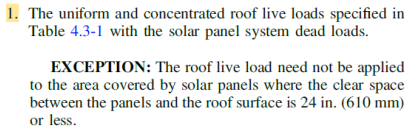
- 1- The uniform and concentrated roof live loads specified in Table 4.3-1 with the solar panel system dead loads. (EXCEPTION: The roof live load need not be applied to the area covered by solar panels where the clear space between the panels and the roof surface is 24 in. (610 mm) or less.)
2- The uniform and concentrated roof live loads specified in Table 4.3-1 without the solar panel system present.
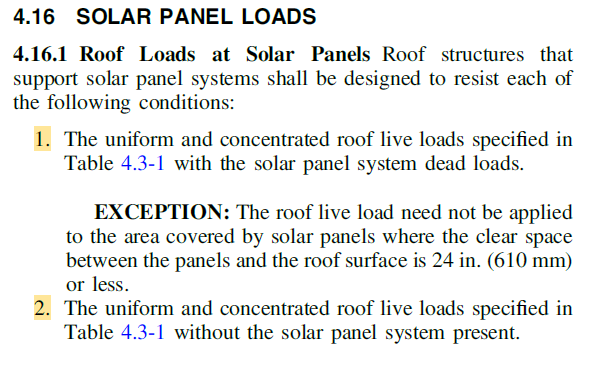
Reference: ASCE-07-22 [1]
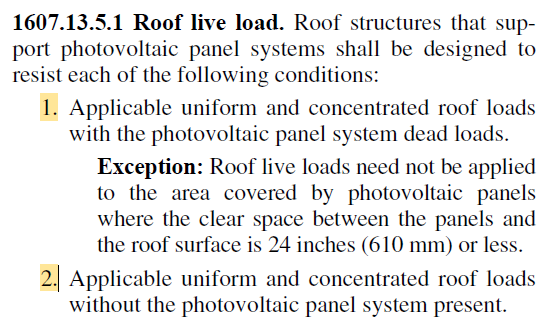
Reference: IBC 2024 [2]
In the section Open-Grid Roof Structures Supporting Solar Panels of ASCE 7-22 [1], which is similar to Section 1607.13.5.2.1 of IBC 2024 [2], it is stated that Structures with open-grid framing and no roof deck or sheathing supporting solar panel systems shall be designed to support the uniform and concentrated roof live loads specified in Table 4.3-1, except that the uniform roof live load shall be permitted to be reduced to 12 psf (0.57 kN/m2).
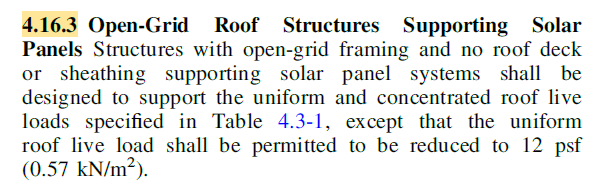
Reference: ASCE-07-22 [1]
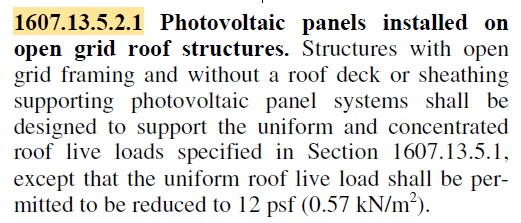
Reference: IBC 2024 [2]
Note: Section 4.16.1 may be misinterpreted to mean that (1) the roof live load need not be applied over the area covered by solar panels, and (2) roof live load is applied only to the portions of the roof not covered by the solar panels. Under this interpretation, one might conclude that if the entire roof is covered by solar panels, no roof live load needs to be applied anywhere. However, Section 4.16.3 clearly states that roof structures supporting solar panels shall be designed for roof live load (where applicable, permitted to be reduced to not less than 12 psf). Therefore, the above conclusion and interpretation is not valid.
The correct interpretation is that the roof structure shall be designed for two conditions:
1- Solar panels installed (in service):
Where solar panels cover portions of the roof and the code exception is applicable, roof live load need not be applied to the solar-panel-covered areas. In this case, the PV system dead load is applied to those covered areas (and roof live load applies only where the exception does not apply or where the roof is not covered).
2- Solar panels not present (not installed yet / removed / future replacement):

The roof must also be checked without the solar panel system present, in which case roof live load may occur over the roof area (e.g., workers, materials, and maintenance activities). Therefore, the roof live load is applied to the roof in accordance with the code requirements.
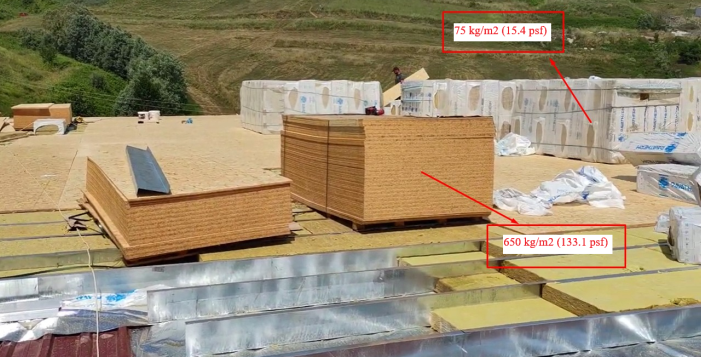
Other references, such as IRC 2018 [3] and ISEP 2021 [4], support this interpretation.
This point is more clearly stated in R324.4.1.1 of IRC 2018 [3], and RS402.2.1.1 of ISEP 2021 [4]:


Portions of roof structures not covered with photovoltaic panel systems shall be designed for dead loads and roof loads in accordance with Sections R301.4 and R301.6.
Portions of roof structures covered with photovoltaic panel systems shall be designed for the following load cases:
1. Dead load (including photovoltaic panel weight) plus snow load in accordance with Table R301.2(1).
2. Dead load (excluding photovoltaic panel weight) plus roof live load or snow load, whichever is greater, in accordance with Section R301.6.
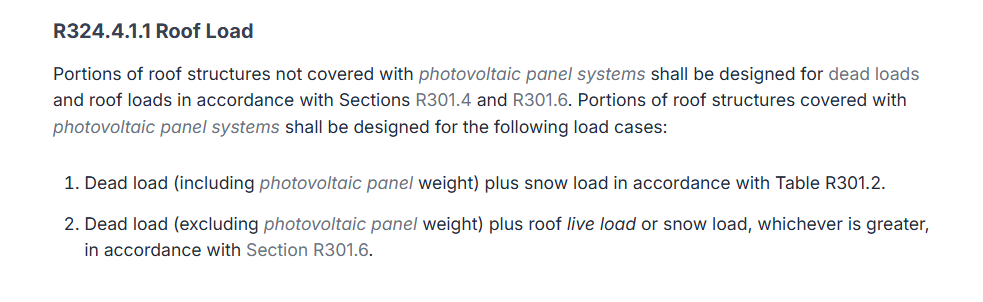
Reference: IRC 2018
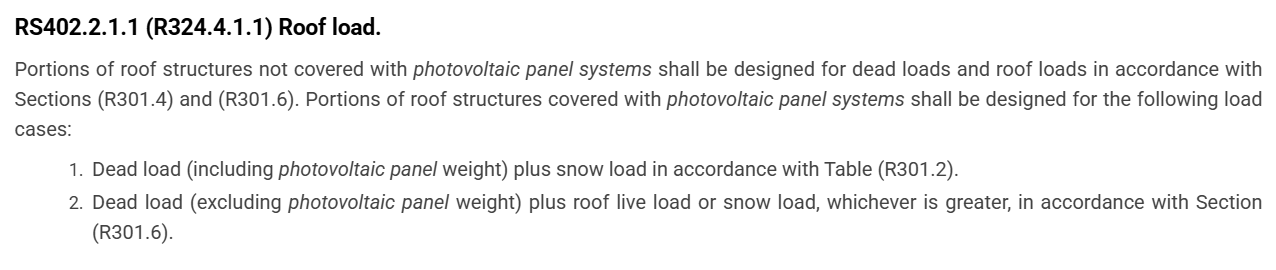
Reference: ISEP 2021
Accordingly, MkaPEB accounts for this point during load generation, analysis and design, ensuring PV-supported roof systems are evaluated in a code-consistent manner.
For example, for below load combinations from Section: 2.3 LOAD COMBINATIONS FOR STRENGTH DESIGN of ASCE 07-22 [1]:
2a) 1.2 D + 1.6 L + ( 0.5 Lr or 0.3 S or 0.5 R)
assuming there is no Live load (L) and Rain Load (R), we have:
2a-1) 1.2 D + 0.3 S
2a-2) 1.2 D + 0.5 Lr
Then
2a-1) 1.2 D + 0.3 S
for roof structures covered with photovoltaic panel systems, we have:
1.2 D (Sheeting+Self+Purlin+Photovoltaic panel weight) + 0.3 S
2a-2) 1.2 D + 0.5 Lr
for roof structures covered with photovoltaic panel systems, we have:
1.2 D (Sheeting+Self+Purlin) + 0.5 Lr
3a) 1.2 D + (1.6 Lr or 1.0S) + 0.5 W
we have:
3a-1) 1.2 D + 1.0 S + 0.5 W
3a-2) 1.2 D + 1.6 Lr
Then,
3a-1) 1.2 D + 1.0 S + 0.5 W
for roof structures covered with photovoltaic panel systems
1.2 D (Sheeting+Self+Purlin+Photovoltaic panel weight) + 1.0 S + 0.5 W
3a-2) 1.2 D + 1.6 Lr
for roof structures covered with photovoltaic panel systems
1.2 D (Sheeting+Self+Purlin) + 1.6 Lr
References:
[1] American Society of Civil Engineers. "Minimum design loads and associated criteria for buildings and other structures." American Society of Civil Engineers, 2022.
[2] International Building Code (IBC), 2024 Edition
[3] 2018 Washington State Residential Code (IRC)
[4] 2021 International Solar Energy Provisions (ISEP)