6- Positive and Negative Internal Pressure
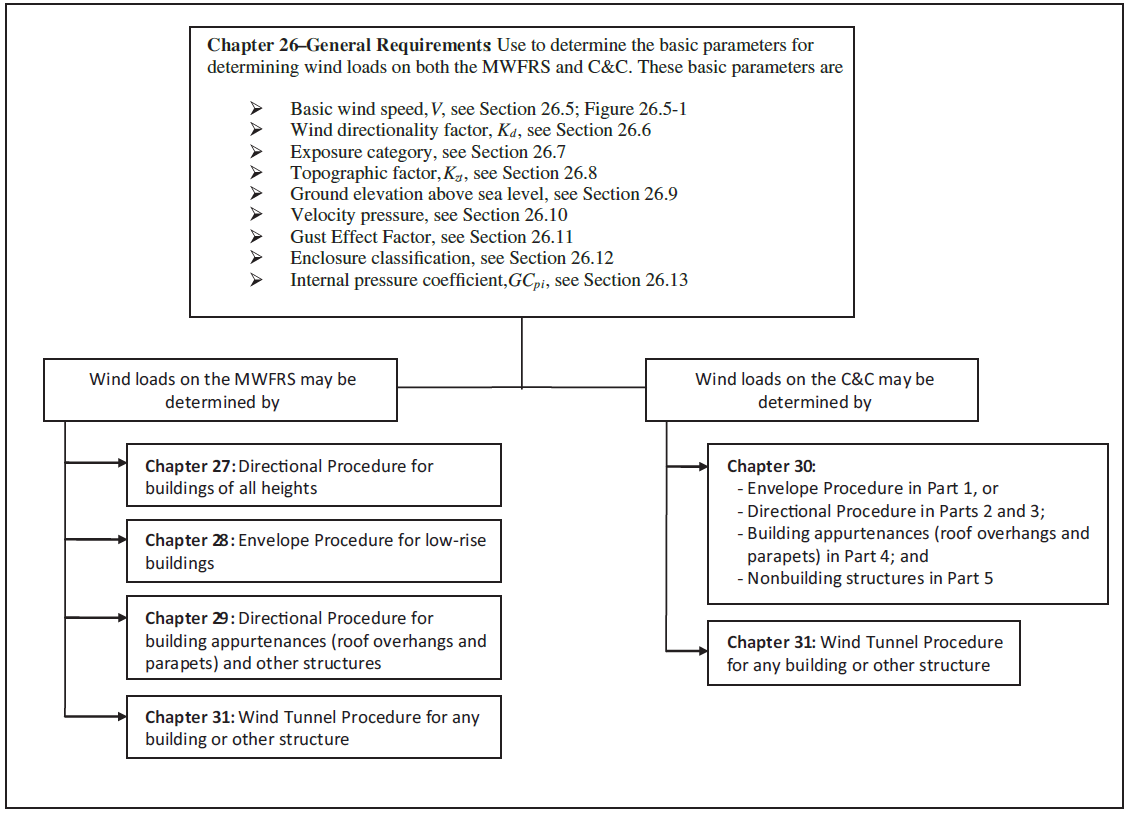
ASCE-07-22 [1] presents wind load determination procedures on MWFRS mainly in Chapter 27 (Directional Procedure) and Chapter 28 (Envelope Procedure, typically for low-rise buildings), and on C&C in Chapter 30.
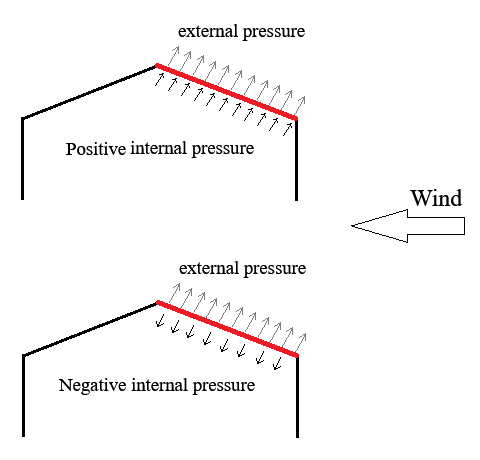
The determination of wind pressures requires consideration of both external and internal pressure coefficients. Table 26.13-1 of ASCE 7-22 provides internal pressure coefficients for buildings with different enclosure classifications. For each non-open building classification, the table specifies two values—one positive and one negative—and both must be considered. Accordingly, for each wind direction (wind from the left, right, back, and front), two load cases are required, representing internal pressure acting toward and away from the interior surfaces (i.e., positive and negative internal pressure).
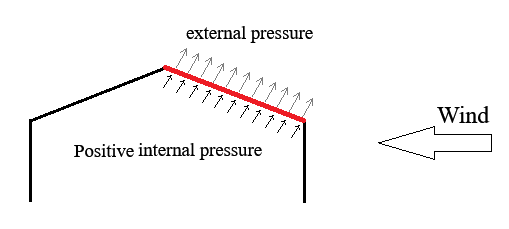
However, due to the computational effort required to calculate and apply all load cases (eight for MWFRS and eight for C&C), designers often simplify the analysis by considering only the most severe loading condition. In practice, this is commonly assumed to occur when the external pressure and internal pressure act in the same direction, producing the largest net pressure on the surface. Consequently, only this governing condition is typically used in design (as illustrated in the figure below).
Although the governing case may be the one identified when wind is considered alone, this is not necessarily true once wind is combined with other gravity loads. When dead load and snow load are included in a load combination—e.g., 1.2D + 1.0S + 0.5W—a different internal-pressure sign (and thus a different wind case) can become more severe and control the design.
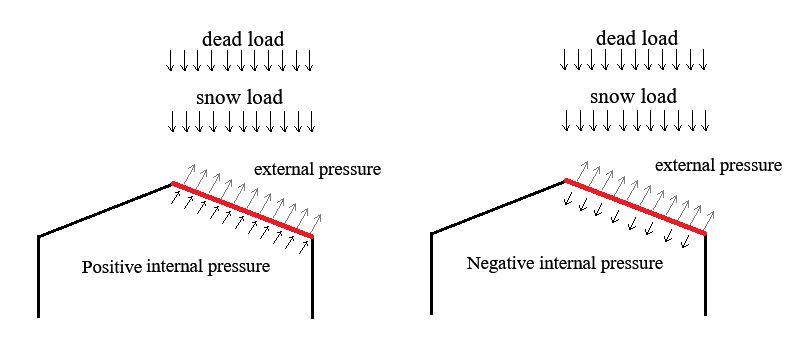
Ignoring this effect, some structural designers consider only the “same-direction” internal/external pressure case as universally governing and do not evaluate the opposite internal-pressure sign within the full set of factored load combinations. As a result, the true controlling combination (e.g., 1.2D + 1.0S + 0.5W) may be missed, which can significantly underestimate both purlin and primary-frame demands and lead to substantially lighter purlins and frames that are neither safe nor code-compliant.
References:
[1] American Society of Civil Engineers. "Minimum design loads and associated criteria for buildings and other structures." American Society of Civil Engineers, 2022.