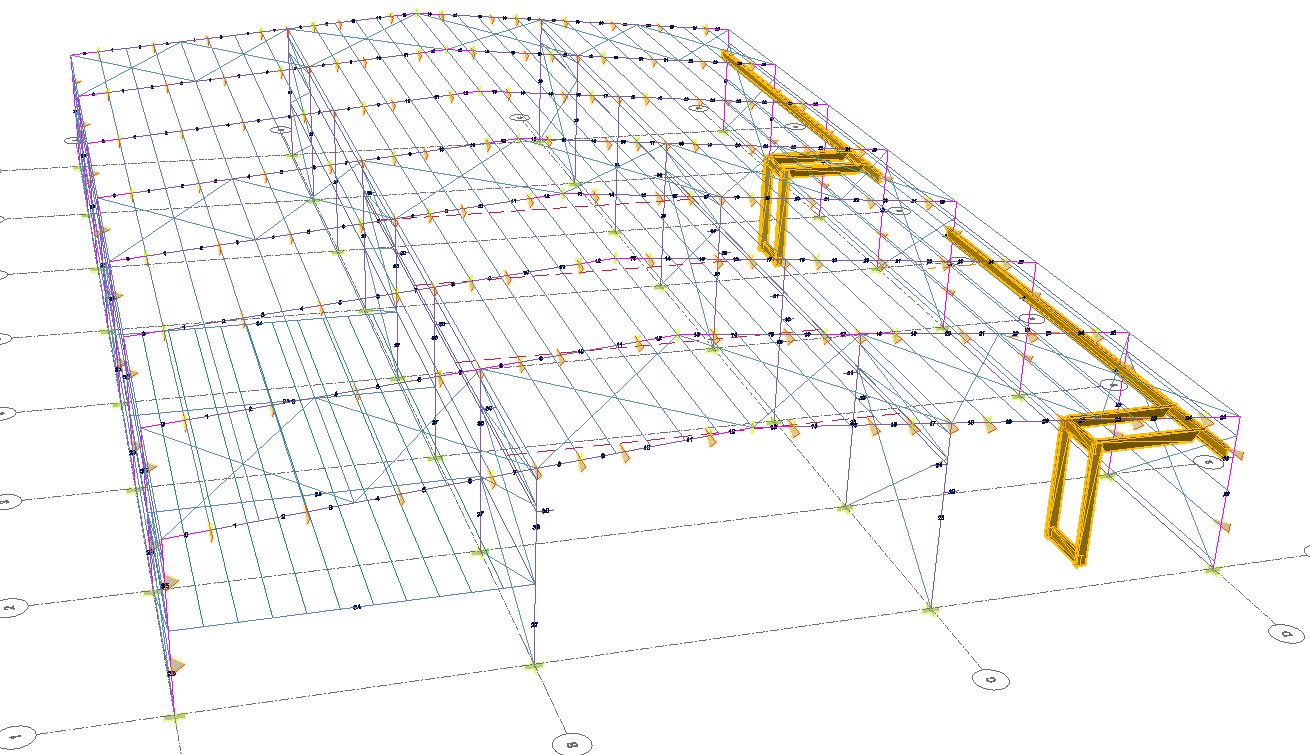
Semi Gantry Cranes
A semi-gantry crane is a crane configuration in which one end of the bridge travels on an elevated runway supported by the building (typically on a column bracket/runway beam), while the other end travels on a ground rail supported by the slab or a dedicated foundation beam. In single-storey steel industrial buildings and PEMBs, semi-gantry cranes are often selected when the operation needs crane coverage along one side of the building without installing two elevated runways—such as along a fabrication line, assembly bay, maintenance area, or loading zone adjacent to an exterior wall or open side.
Semi-gantry cranes provide a practical balance between capability and cost. Compared with a fully elevated overhead crane system, they can reduce steelwork and detailing on one side of the building while still enabling efficient lifting and material flow. In procurement terms, semi-gantry cranes are frequently used as a scalable solution: they support heavy handling requirements with a simpler runway arrangement, and they can be easier to integrate into phased projects or facilities with constraints on column lines, wall openings, or equipment zones.
From an engineering perspective, considering semi-gantry cranes in design is critical because they introduce asymmetric and mixed support actions that can govern member forces and foundation demands. The elevated side delivers concentrated wheel loads, dynamic/impact effects, and horizontal forces (from acceleration/braking and skewing) into runway beams, brackets, and the primary frames—similar to overhead cranes—while the ground-rail side transfers significant reactions into the slab and foundations, often requiring careful checks for rail support, anchorage, local bearing, and differential settlement. This asymmetry can amplify column moments and torsional effects, alter bracing demands, and impose serviceability requirements related to runway alignment and rail levelness. If semi-gantry effects are underestimated or simplified, projects can face rail misalignment, excessive runway deflection, bracket/connection distress, unexpected foundation strengthening, or operational limitations after commissioning.
MkaPEB enables you to model and analyze semi-gantry crane systems as an integrated part of the building, not as an external assumption. You can define the elevated runway geometry and loading parameters and taken into account of associated reactions within the same analysis/design workflow used for the primary PEMB structure. This allows you to present clear model views and result screenshots—runway framing and brackets, rail-supported boundary conditions, crane load cases, frame responses, member demand/capacity outputs, and support reactions—demonstrating to owners and reviewers that semi-gantry crane actions and their asymmetric load path have been explicitly and professionally addressed for a safer, more reliable, and more economical building.