Limitations from AISC 360
The members of Pre-Engineered Metal Buildings are required to be designed and detailed in accordance with AISC360-22 [1].
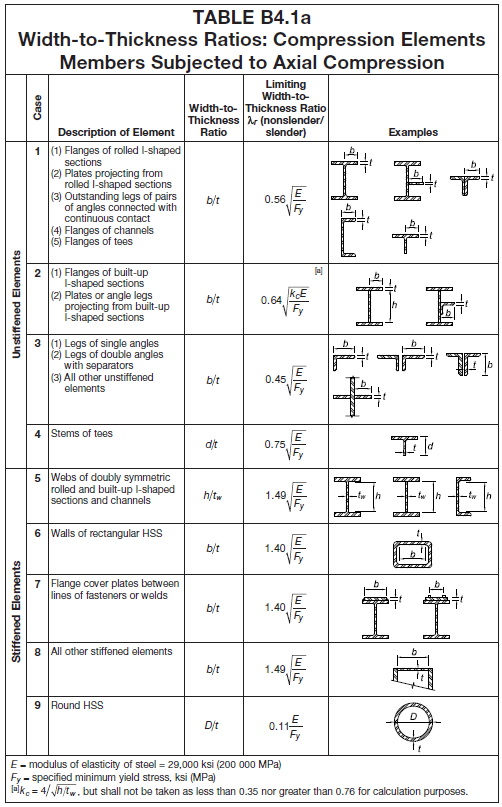
According to AISC 360-22 [1], for members subjected to axial compression, sections are classified as non slender element or slender-element sections. For a non slender element section, the width-to thickness ratios of its compression elements shall not exceed λr from Table B4.1a. If the width-to-thickness ratio of any compression element exceeds λr, the section is a slender-element section.
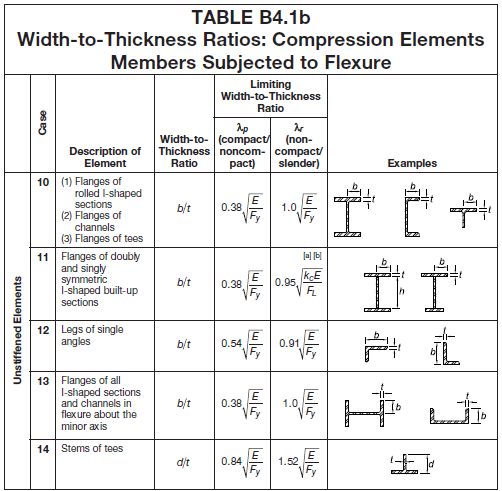
For members subjected to flexure, sections are classified as compact, noncompact, or slender-element sections. For all sections addressed in Table B4.1b, flanges must be continuously connected to the web or webs. For a section to qualify as compact, the width-to-thickness ratios of its compression elements shall not exceed the limiting width-to thickness ratios, λp, from Table B4.1b. If the width-to-thickness ratio of one or more compression elements exceeds λp, but does not exceed λr from Table B4.1b, the section is noncompact. If the width-to-thickness ratio of any compression element exceeds λr, the section is a slender-element section.
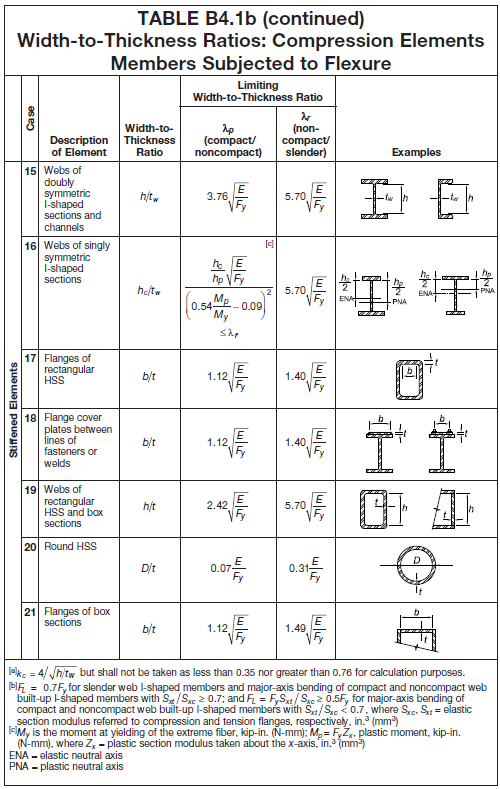
Based on these classifications, MkaPEB applies all applicable limitations and requirements specified in this specification.
References:
[1] American Institute of Steel Construction, 2022. Specification for Structural Steel Buildings. American Institute of Steel Construction.